
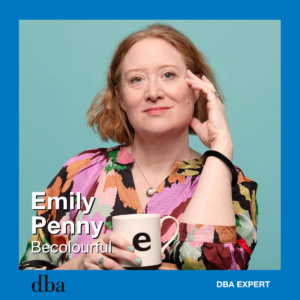
Emily heads up Becolourful, a brand voice studio that supports agencies with brand positioning and content. She’ll help you go beyond generic promises and align on a point of view, so you can have conversations, not just sell.
Main Content

17/06/2026
Rules & Rebels: How design agencies tell their own stories
Design agencies lack confidence when it comes to their own words. How do you navigate the verbal culture of the boardroom, visibility in search, and the demands of the algorithm – while showing up as creative?
 Designers are famously reluctant to treat their own businesses as brands in the way they might for clients. I’ve always liked D8’s deadpan declaration: “without a slogan since 1999” – and there’s a truth in the humour. It’s hard to find the words to stand by.
I examined agency messaging in detail as co-author of the Fully Saturated report. We analysed the positioning and language of hundreds of studios, determined to unearth some gems in a very repetitive verbal landscape. We were looking for three things: the angle, the relevance, and the memorability.
The Chase’s storytelling has survived for 40 years, landing the idea that every element must have a reason for being. Asked how he carves elephants, an accomplished craftsman answers: “I just cut away the wood that doesn’t look like an elephant.” It’s a thought-provoking and re-tellable story that speaks of instinct and strategic design. We were also struck by Analogue Creative’s “seriously playful” positioning, which is both promise and vibe, and Among Equals’ foundational mantra “Start with no-one cares.”
These are hard-working words, but in this sector there’s an abundance of language that does little more than explain the role of design: standing out, bringing your brand to life, making a difference, connecting with audiences. Let’s revisit Among Equals’ truth bomb; it’s relevant in the design sector just as any other. If no one cares about your agency, what are you doing to change that?
Writing isn't optional
We know there’s an in-built reluctance to go all-in on creative messaging, which likely derives from a reliance on portfolios to tell the story and the absence of in-house skills. Most agencies are small businesses, and few small businesses have in-house writers. But we also know that marketing is not optional, so you need to find your voice. Daniel Poll, founder of Noramble told us, “In the past, agencies have used their work quality and process to gain the advantage. Having a stand or a viewpoint within your agency messaging is what can really help you relate to clients looking, because great work is everywhere these days.”
This is a people-driven sector, but there are times when your words need to stand alone and do the hard lifting, even if it’s not a full-blown multi-channel marketing campaign (though maybe it could be, or should be? Just a thought).
So how do you choose the words that sit on your home page, on your LinkedIn page, and what do you opt for in that hateful moment when you’re asked for a company bio? When forced to articulate something versus nothing, the next challenge is balancing the pressure to be sensible and follow the rules, while also secretly wanting to be altogether more rebellious.
The comfort of rules
When the pipeline is running dry and you need to make briefs happen, following the rules feels like the safest option. Every business wants an easy win – even though it’s likely not what studios advise for clients; they call for bravery and big ideas.
First SEO brought rules, striking the first blow to the idiosyncrasy of words, as the whole point is to chime with the most commonly used terms. Since then, with LinkedIn as the dominant B2B platform, it’s sensible to appease the algorithm, which rewards clear niching and narrow topic ownership. These are valid rules and well worth knowing, but we need to be aware that online environments are shaping language and reducing our vocabulary. And this could be opening up an opportunity for those that choose not to play by them.
Agencies should know the rules and stick to them to a certain degree, but this piece is all about defining that degree. Just as with design practice, great words don’t simply come from rules, they come from breaking the mould and choosing when to deviate.
AI strengthens the case for brand
There’s now a new holy grail in marketing: visibility in AI answers. The interesting thing here is that AI is a much more sophisticated form of search. It can tell the generic from the genuine and noteworthy. Businesses with something unique and valuable to say are rewarded for it. This means there’s a very good reason to build a brand, not just a sales machine. And this should be music to the ears of creatives. If any sector is permitted to wear its weird on its sleeve – surely this is it?
When word salad wilts
But there are other constraining factors too. On the face of it, no one celebrates corporate language; words like ‘elevate’ are frequently mocked but at the same time accepted as a necessary evil. The biggest influence on agency language right now comes from the verbal culture of the boardroom. We see promises of change, transformation, growth, and scale. And while there’s huge benefit in speaking to your audiences’ ambitions and pain points, and using their language, if this shows up as simplistic unsubstantiated tropes, it starts to work against you as clients can’t tell one agency from another.
Let’s think smarter: make commercial promises grounded in the effectiveness of your design, but bring your hard-earned nuanced insight to the table (or deck, or screen). Surprise clients with your incisiveness. Own a more interesting angle on how you will uniquely deliver widely promised commercial outcomes, for example see how EatBigFish brings deep insight into what it means to be a challenger brand. Lean into attributes that go beyond a textbook explanation of design, because the clients you really want already understands design; they just need to know why to work with you.
Creatives getting creative
Our Fully Saturated report champions agencies that think like brands. That means ownable ideas and distinctive language that bring greater relevance, believability and, crucially – premiumisation. This, we know, is the payback of thinking like a brand: to rise above the competition and command higher fees. A brand works hard to avoid being seen as a replaceable commodity service.
How can natural-born rebels navigate the rules of language?
I think about messaging in strata. Know the rules, follow the best practices, hit the key words, but then layer on something more authentic and imaginative. The really good stuff comes from defining your true values, knowing what you deliver that goes beyond the expectation of the sector, and articulating a point of view.
When rebels rise
 I spend all day every day working on B2B positioning and language and have come to the conclusion that the most powerful stories are infused with genuine personal experience and personality, not from following rules or playing the part. After all, design clients are people too and in the midst of a day of pitches, they want something that will wake them up.
In the report, we show how I Am Female studio makes a virtue out of being queer-led and brings a punchy attitude with it, “CREATIVITY. INNOVATION. BLAH BLAH BLAH… We’re the queer-led brand communications agency for brands tired of the same-old sh*t.” It stands out and increases relevance for a particular kind of client. And we showcase Land of Plenty’s unmissable commitment to ethics. This agency comes with a strong point of view: “People love the products and experiences you create. They just want to know you’re not delivering them at a cost to the planet. It’s about small steps towards being better, not huge claims of being perfect.”
The good news is that if your agency is a good one, those deeply-held provocations or quirks are already there, albeit hidden in a bid to show up as professional. Perhaps it’s time to let your inner rebel have some airtime too. I’m certain you won’t regret it.
Image credits: Felicity Tai | Becolourful | Bailey Mahon
Expert advice
DBA Experts are accredited expert consultants who have sustained and relevant experience in supporting the design industry. Our Experts are:
DBA approved.
Recommended by peers.
Reference checked.