
DBA appoints new Board Director at AGM
The DBA welcomed Phoenix Studios’ Managing Partner and Founder, Jonny Westcar to the Board of Directors at its AGM.

Often the Forums take the form of invited guests giving insight or provocation to spark discussion, sometimes we set a question or ask for opinion. All of the sessions have been beneficial, but here are a few which particularly stood out for me this year.
 Blair Enns joined us in January to talk about creative businesses selling their expertise and how to move out of a ‘vendor’ position in the sale. Blair is a long-time friend of the DBA and there are not many members who are not aware of his philosophy and expertise when it comes to positioning and sales. This was an excellent opportunity to dig into the detail and ask questions, with the conversation spanning Blair’s ‘one client at a time’ approach, to the role of business owners in the sale, and much more.
In April, Mark Curtis formerly of Accenture Song (and founder of Fjord) talked us through the Lifestyle Trends Report, a fascinating insight into the factors impacting not just consumer behaviour on the high street, but also those buying design services. Of the many pertinent points Mark shared, the two that stood out for me were ‘Data Overload’ where we have access to so much information we don’t know what to do with it, and ‘Decision Paralysis’ from a position of fear of making the wrong decision – the irony of course being that not making a decision is usually the worst option.
The age-old issue of free pitching was addressed in May after a flurry of social media posts in the month before had attracted a lot of attention. We took the opportunity to spotlight members from a range of specialisms who do not free pitch as proof that there is a better way to win work and run your business. The DBA Code of Conduct recommends that members do not free pitch, and we can help you transition to this mindset. If you’d like to explore this further in 2026, drop me a line at adam@dba.org.uk to set up a call. We also have a wide range of guidance members can tap into online.
The membership of the DBA has two core constituents – design agencies, and in-house teams at large corporates. In October, we brought these together by inviting three global design leaders from large corporations to talk openly about the issues and pressures within their businesses and how they impact the design decisions that are made. This was an excellent opportunity to understand the constraints that some clients are operating under, as they too are trying to elevate the importance of design within their businesses.
 Don’t miss our first Forum of 2026 – taking place on 12 January from 13:30 to 14:30 in our new regular lunchtime slot.
We’re going to be focussing on working internationally and will be joined by DBA members representing a range of sectors, including PriestmanGoode’s Kirsty Dias and forpeople’s Chris Hacking, who’ll be sharing their experiences and perspectives so you too can grow your impact abroad.
You can find more details below, along with a snapshot of all the conversations from this year’s Member Forums.

Selling expertise
If you’re selling your expertise in a creative business, these top tips from Blair Enns will help you move from a vendor to expert. Take it one client at a time and navigate tricky conversations with more confidence. Read more.

How AI is reshaping the way we work
From productivity gains to integrating AI as a brand management tool, DBA members shared practical ways they’re incorporating AI into their day-to-day work – with some useful legal advice along the way. Read more.

Productivity vs creativity
Does over monitoring stifle creativity? Finding the balance between structured and unstructured time, and allowing time to rest, were among the insights shared by Alex Soojung-Kim Pang. Read more.
Accenture Life Trends 2025 Report
How are people’s behaviours and attitudes shifting, and what does this mean for our businesses? A fascinating look at the latest Accenture Life Trends Report. Read more.
Say no to free pitching
Practical and inspiring ways to push back against free pitching from a range of DBA members. From clear policies to building stronger client relationships – there’s much more you can do. Read more.
Design education
We explored design education with contributors ranging from university leaders to design business owners to recent graduates. These conversations will continue in 2026. Read more.
Author special
From service design to human centred creative leadership, if you’re looking for an inspiring Christmas read, look no further than these two books. Read more.
Plus, check out the DBA recommended reading.
Build new business momentum
How can you tap into your network and stay ahead of trends? Practical, strategic advice from DBA Expert and new business specialist, Lucy Mann – relevant at any point in the year. Read more.
The in-house perspective
What is really going on inside large organisations? How are the current market conditions shaping the way they work with agencies? A fascinating conversation with three in-house design leaders. Read more.

In Focus Report special
Maximising profitability, recovery rates, golden ratios and key trends from the DBA’s 2025 In Focus Report were just some of the insights we explored in detail. Read more.

Inspirational perspectives on 2026
“What one experience this year will influence how you do business in 2026?” We asked an eclectic group of thinkers to share their views. From sustainability to AI to leadership endurance. Read more.
Don’t miss our first meeting of 2026
Taking place on Monday 12 January at the new time of 13:30-14:30 we’re going to be diving into working internationally, with member-led strategic insight. Read more.
The DBA Member Forums offer exclusive access to insights and discussions that will impact you and the way you run your business.
One inclusive and friendly hour a month to engage with your industry at a level you won’t get access to anywhere else.








Here’s a summary, prepared under Chatham House Rule, to give you a flavour of the responses:
Our next DBA Member Forum is on Monday 12 January at our new time of 1.30pm GMT.
Nicola has spent more than two decades in the design industry, most of them at creative and digital agency HMA, where she has played a central role in shaping the agency’s growth and strategic direction. Under her leadership, HMA has developed a strong specialism in health, life sciences, and technology, delivering impactful work for NHS organisations, third-sector partners, start-up innovators, global pharmaceutical companies, and academic research teams.
She also contributes to the wider health-tech innovation landscape, delivering masterclasses and mentoring on digital health accelerator programmes and, more recently, helping to strengthen collaboration between industry and academia through her role on the industry sub-committee for the NIHR HealthTech Research Centre in Long-Term Conditions (Devices for Dignity).
Passionate about nurturing future talent and highlighting the breadth of careers within the creative and digital sectors, Nicola works closely with local schools and colleges – integrating digital components into design courses, setting live briefs, conducting mock interviews, and taking part in careers events and panel discussions.
Nicola joined the DBA Board of Directors in 2022, bringing deep industry experience and long-standing agency leadership to support the association’s strategic development and the wider design community.
 “It’s both a privilege and a responsibility to take on the role of Chair at this point in time. Our industry is experiencing unprecedented transformation – from the rise of AI and emerging technologies to economic pressures, talent challenges, and an increasing need to demonstrate the true value of design. This is a critical moment for us to unite, champion effective design, and show the tangible difference our work can make to businesses, communities, and society.
I’d also like to take this opportunity to thank my predecessor, Warren Hutchinson, for his leadership, insight, and dedication during his tenure as Chair. His contribution has undoubtedly strengthened the DBA for the benefit of its members and the wider industry”
Nicola Tiffany, MD, HMA and Chair of the DBA Board of Directors
“I’m delighted to be working with Nicola, as Chair of the DBA Board of Directors , over the next three years. She’ll be the critical support that I need and the hands that guide the board. But I’m especially excited about the fact that she’ll be an inspiration to many with ambitions of leadership in the design industry. We need strong leaders in a time of transformational change, people who will champion creativity and human ingenuity, while building innovative ways of working made possible because of technological advances. Nicola sits on a seat that will give the DBA the advantage of seeing what’s coming at the sector.” Deborah Dawton, DBA Chief Executive
The Design Business Association (DBA) is the design industry’s trade association. Elected by the membership, the Directors of the DBA are a mix of DBA members and other design industry experts with extensive experience of integrating design into business strategy at executive level. They collaborate closely with the DBA’s management team to elevate the role of design in business and government and build confidence in design investment.
DBA Directors include Tim Duncan, Founder and MD, TDC PR, Louise French, Global Operations Director, forpeople, Khadija Kapacee, Co-founder and MD, EDIT Brand Studio, Georgina Leigh-Pemberton, MD, Turner Duckworth, Deborah Longbottom, Treasurer, Simon Ritchie, Global Design Lead, Marketing Excellence, Haleon, Matt Round, Chief Creative Officer, tangerine, Andy Sexton, Partner and ECD, 2LK, Nicola Tiffany, MD, HMA, Stephanie Verschoor, Head of Design & New Digital Solutions, NatWest Group.

“We were steady, profitable and proud of our work,” says Steve Gill, Forepoint’s Managing Partner, “but we wanted to be more deliberate about where we were heading. We needed a stronger proposition and to be more strategic in how we grew, and we knew that if we got that right, the confidence of the whole business would follow.”
The partners already knew of DBA Expert Ralph Ardill’s work with other creative businesses and sought his perspective. With decades of top-level client and agency-side experience, he had helped design firms reinvent themselves through the same imagination and discipline they offer their clients. What began as a conversation about strategy and confidence quickly opened into a broader dialogue about purpose, performance and the future shape of the business.
Ralph reframed the challenge. What Forepoint needed wasn’t another round of tweaks or away days. It needed a transformation approach rooted in purpose, lived in practice and built to last.
“From our first meeting it was clear this was not about fixing anything broken. It was about unlocking potential,” reflects Ralph Ardill. “I introduced my proven creative-transformation framework, developed over decades with world-class clients and agencies, to help Forepoint rediscover who they are, what they stand for and how they grow. It was about embedding a new way of building confidence, capability and momentum across the business.”
The partners and leadership team began a structured journey with cross-disciplinary teams tackling briefs across the key drivers of agency value: commercial, creative, cultural and client. At heart, it was a creative endeavour with Ralph re-imagining business transformation for agency life.
“The moment we started treating the agency as a creative project, everything changed,” says Forepoint’s Creative Director, Keith Noble. “The energy in the studio lifted. People felt involved, responsible and proud again. It gave everyone permission to bring their best thinking to the table.”

As momentum built, the framework embedded a living system for growth, reviewing progress, celebrating wins and setting transformation briefs for the year ahead. What began as an experiment became Forepoint’s new way for guiding its own future. “That moment was a real turning point. For the first time we could see the whole business working as one: one purpose, one plan, one energy,” says Steve.
“We never talked about change as a business project. We treated it as a creative transformation brief, structured, collaborative and focused on the areas that drive the greatest value,” highlights Ralph. “Its power lies in combining commerce with creativity, imagination with discipline and turning ambition into results you can see every day.”
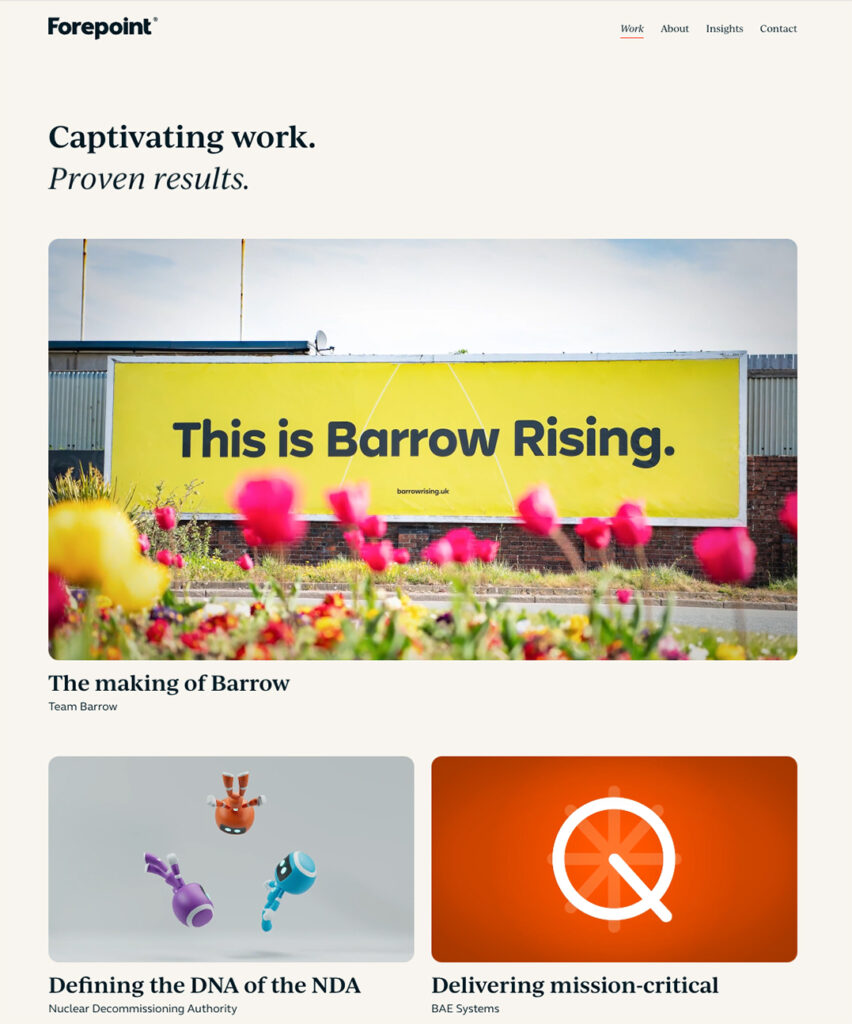 A shared value proposition soon emerged. Forepoint now knew exactly who they were for, why they mattered and where they had the greatest right to win. Teams became more self-assured and conversations with clients more confident.
“We have now got the clearest sense of who we are and what we stand for that we have ever had,” says Steve. “That shared understanding has made every decision simpler and given everyone in the business a new sense of confidence.”
Each year, the journey is now marked by Forepoint’s annual Captivation away day, celebrating progress, sharing learning and setting fresh priorities. The work also created a platform for the next generation of Forepoint leaders to step forward. Ownership now sits across the business, ensuring the approach lives on beyond any single individual.
“It is not about top-down directives anymore. The framework gives everyone a way to think and act creatively about the business itself. That is the real culture shift,” reflects Keith.
That shared ownership has rekindled pride across the agency and a renewed sense that Forepoint controls its own destiny.
The transformation has also delivered a series of impressive agency firsts:
The biggest single client win in Forepoint’s history, new consulting services, value-priced client programmes and a next-generation management team. Creative standards, confidence and consistency have never been higher, proof that transformation can touch every part of an agency when it is owned by everyone.
Over the last two years turnover has risen from £1.9 million to £2.8 million and gross profit from £1.4 million to £2.0 million supported by record staff engagement, stronger board-level client relationships and a continued shift from projects to programmes of work.
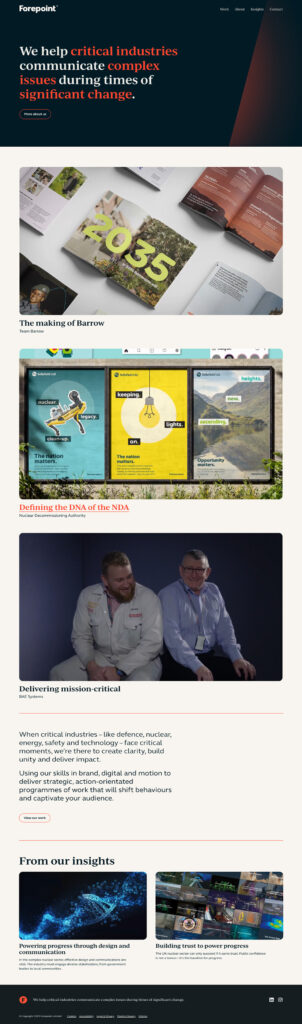
The new Forepoint website captures the clarity and assurance that now defines their work. Externally, Forepoint is being invited into higher-value conversations and industry forums. Internally, pride and purpose have never been stronger.
“The results speak for themselves,” says Steve. “But for me the biggest change is confidence in our direction, our offer and our team. We are prouder than ever to talk about Forepoint, and our clients can feel that difference.”
“Creatively we are in the best place we have been for years,” adds Keith. “We are seeing bolder ideas, faster decisions and better collaboration. All proof that culture drives performance.”
 Forepoint’s success lies in the blend of courage, focus and commitment. The team embraced a challenging but proven approach and made it their own. They invested consistently and treated transformation as a creative act, not a management exercise.
Start with possibility, not pressure
Know who you are, why you matter and where you want to go next.
Treat your business as your most important brief.
Use the same imagination, discipline and craft you give your clients.
Build a system, not a sticking plaster.
Keep it alive year after year.
Be the change together.
Involve everyone to turn participation into pride.
Become your own best case-study.
Design the business you want to be then live it.
Says Steve: “We’ve gone into this with our eyes open, we know change is hard, not everything will work and we’ll make mistakes along the way but as long as we stick to the plan, keep pushing, keep learning and keep improving we’re more excited than ever to see what the next chapter of our story holds.”

Forepoint continues to work closely with Ralph, applying the same framework to its future growth plans, building the future management team and winning ongoing programmes with new and existing clients.
“What we’re building isn’t just a stronger business, it is a model for how creativity can keep unlocking an agency’s future,” says Ralph. “I’m bringing my framework and experience, Forepoint are making it their own and together we’re delivering the next chapter, not just dreaming about it. That’s where the real transformation lives.”
“We set out to reinvigorate the business and along the way we’ve reinvigorated ourselves,” reflects Steve. “With a business we believe in again that now has the confidence, focus and approach to write our own next chapter and encourage other agencies to believe that meaningful change is possible, even in these uncertain times.”
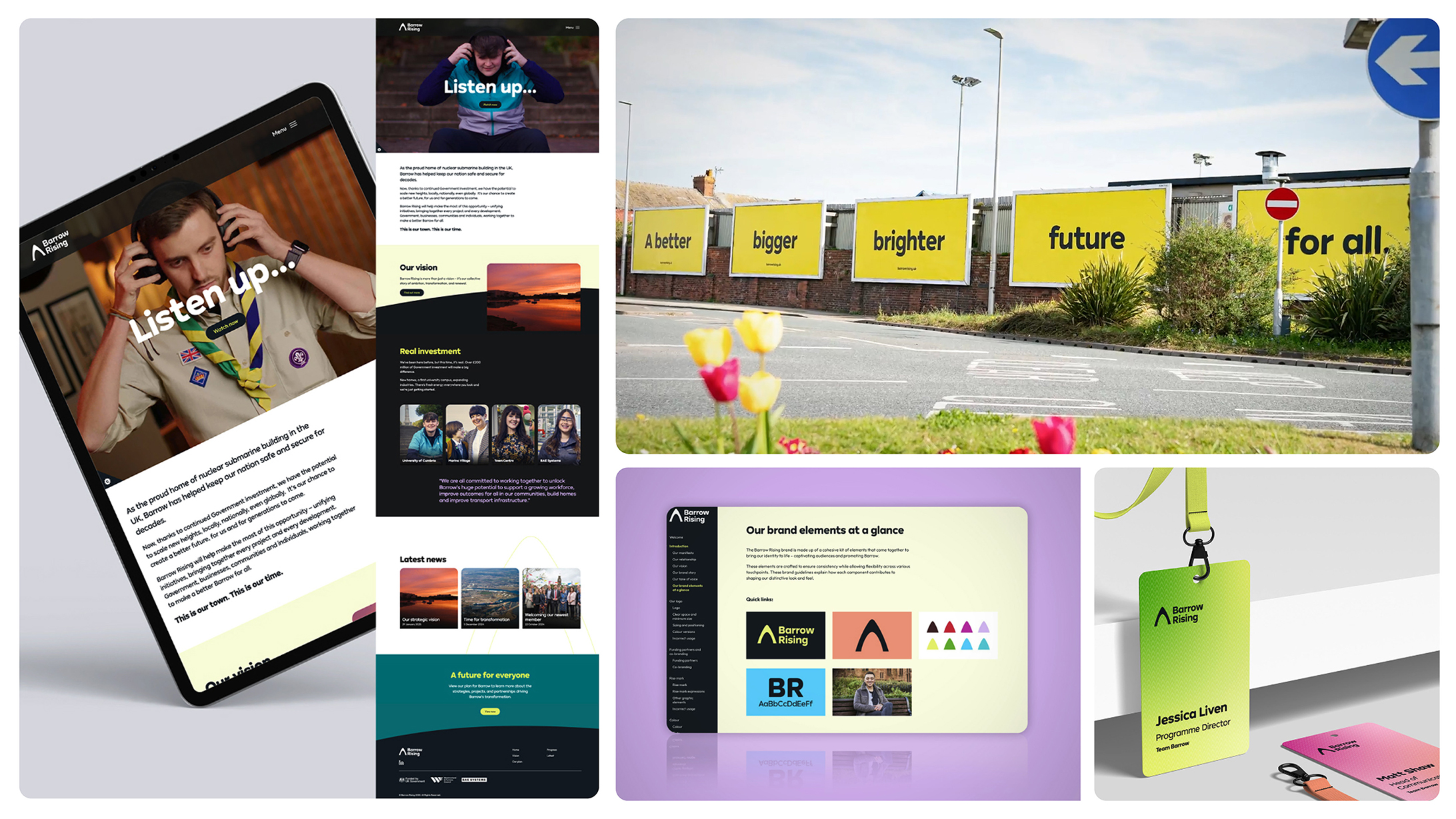
The making of Barrow: find out more about Barrow Rising
DBA Experts are here to help you navigate the challenges and decisions you face as you grow your business. Our register of accredited expert consultants have sustained and relevant experience in supporting the design industry, so you can rest assured that you will be getting sound, high-level support.
Our Experts have extensive experience supporting the creative industries and are:
DBA approved.
Recommended by peers.
Reference checked.
 Having a mentor with a vast wealth of experience, who helps you better understand the opportunities for your business and to tackle your fears in a supportive, exploratory way, can help you take a firm control of your agency’s future and deliver transformational results.
“Speak to previous cohorts and I guarantee you’ll jump on it like a shot.” That’s the advice a previous Twenty/Twenty mentee gave to anyone considering the programme, and here’s what a few others had to say about the experience:
“I couldn’t recommend it more highly.”
“Genuinely pivotal.”
“Investing in yourself is one of the most effective things you can do.”
“As a business owner with vision, goals and struggles, the value of being able to learn from, and bounce ideas off someone who has already walked a similar path can only be beneficial.”
“Almost every session reveals something that is incredibly helpful, insightful or that was hidden in plain sight!”
The Twenty/Twenty programme is crafted for leaders in design looking to make their next big leap. Whether you’re focused on strategic growth, succession planning, scaling your business or the design function within your organisation – or something entirely different, imagine what you could do with a mentor by your side. Here are just a few of the reasons previous mentees have signed up:
“I felt I could do with some external advice and input to help us gear up for our next phase.”
“I was at a stage in my business where I wanted to grow it, but I needed to grow myself first.”
“My 60th birthday was coming up in a few years’ time, and I wanted to explore complementary or even different career paths in a safe space, and with someone who could help me realise what I wouldn’t be able to see for myself.”
“At 31 years old, I had spent most of my career in one agency and I really felt that I needed some external guidance and inspiration, some input and support that came from a different context.”
“The opportunity to learn from someone vastly more experienced at running a design business was too good to pass up.”
“Twenty/Twenty mentoring helped grow my confidence tenfold.”
“Mentoring helped me navigate some particular business challenges at a time when I didn’t have many answers to them.”
“For me, the access and exposure I got to another creative business through the programme was as impactful as the relationship I built over the year. I came away from the experience with a whole network of new contacts and learning, many of whom I am still in good contact with today.”
“This process immediately benefitted my new position – I was able to have challenging conversations that I might have previously shied away from.”
“Speaking to someone with deep expertise and experience, who has been through it all, provides incredible context.”
“Our conversations gave me both practical advice and reassurance that was invaluable in the coming years.”
“I would whole heartedly recommend the experience not only from a personal development standpoint, but also in terms of return on investment to the business.”
DBA mentors are industry icons – visionaries from renowned DBA member businesses who bring a wealth of experience and a unique perspective. Our extensive matching process ensures you’re paired with a mentor whose journey aligns with yours, creating a truly impactful partnership. Our mentors come from organisations including: 2LK Design | Chaos Design | Coley Porter Bell | Design4Retail | ECHO | Else | PB Creative | Nestlé and many more.

“The Twenty/Twenty programme is a win/win for both mentees and mentors.”
Eric Quint, former Chief Design Officer at 3M and previous DBA Twenty/Twenty mentor.
Step into the next stage of your career and unlock your full potential. Full details about the programme can be found here.
DBA members benefit from a reduced rate to participate in the programme. DBA members: £1999+ vat | Standard: £3500+ vat.
Applications are open, closing on 28 November 2025. Apply via this form or get in touch with Natasha Papa to discuss the programme.

Here’s a summary of what was discussed in the meeting, prepared under Chatham House Rule:
Our next DBA Members’ Forum is on Tuesday 2 December at 4pm GMT.
Building strong relationships is about meeting each other’s needs, being valuable, and ultimately becoming indispensable.
But being indispensable isn’t about doing more — it’s about doing what truly matters.
It’s easy to fall into a reactive rhythm with clients. They call, you answer. They say, “Can you just…” and you say yes because saying no feels like closing a door. Yet every “yes” adds another task with no job number, no scope, and often, no strategic return.
The truth is, growth-building relationships aren’t created through reactivity. They’re built on value — on the kind of partnership that helps clients think, decide, and move forward with confidence.
The goal is to become the person your client calls when they need a sounding board, a strategic challenger, or a trusted ally to help them evaluate choices, handle risk, or navigate internal politics. That kind of indispensable partnership doesn’t just happen — it’s built intentionally and strategically.
And at the heart of it lies trust.
Trust grows when you consistently demonstrate the right partnership behaviours.
1. Be business-minded
Show that you understand business — their business, your business, and the business of doing business. Demonstrate that you recognise the weight of their world: the commercial pressures, the accountability, the career stakes.
Then use your expertise to solve real business challenges, not just creative ones. When clients see that you grasp both the logic and emotion of their commercial reality, they start to see you as someone who’s in it with them, not just working for them.
2. Speak the right language
Respect the time-short, outcomes-oriented environment your clients operate in. Lead with impact, not process. Talk about the difference your recommendations will make — not the steps involved in getting there.
Process belongs to project managers; outcomes belong to partners.
Be succinct, confident, and clear. Land your key point quickly — the “how” can come later. When you respect their time and decision-making context, you earn credibility.
3. Be proactive
Anticipate needs before they surface. Understand your clients’ world well enough to spot risks, opportunities, and misalignments before they do. Don’t wait for instruction — bring ideas, insights, and perspective. Share what you’re seeing in other sectors. Flag issues early.
Clients want agencies that lead, not those that merely deliver. Proactivity shows investment — it signals that you care about their success beyond the brief.
4. Be emotionally intelligent
Partnership is built on emotional awareness as much as strategic acumen. Understand and manage emotions — yours and theirs — to build trust and navigate challenges. Recognise how your tone, timing, and attitude shape their perception of you and your agency. Listen for what’s unsaid as much as what’s spoken.
It’s about tuning into how the client feels, not just what they say. When ambiguity arises, check it. Clarify it. Emotional intelligence turns friction into flow.
5. Be agile
Agility isn’t about saying yes to every change request. It’s about responding with curiosity and flexibility. Ask why. Reframe to test the purpose and desired outcome. Think inventively about how to deliver what’s needed in smarter, more effective ways.
Being agile means adapting fast — but always with intention, not reaction. The most trusted partners respond to change without losing clarity or direction.
Partnership isn’t about over-servicing; it’s about over-delivering on value. It’s about knowing when to say yes, when to question, and when to lead.
Because when clients experience that level of partnership — where you help them think, not just act — you don’t need to prove your indispensability. You already are.

As the world around us changes, one thing remains constant; the ability of designers to create solutions and reinterpret challenges into new ways of thinking and shape the way forward.
The DBA Design Effectiveness Awards are the most rigorous standard for measuring the effectiveness of design, rewarding entries that have demonstrated the value of investing in design to drive business and societal success.
Much more will be revealed about this year’s list of winners at The Design Effect event in March 2026, and we encourage you to read the winning case studies when they are published online at that time. Understanding what makes a winning case study goes much deeper than the project name and accompanying pictures – these aren’t like other awards.
Projects may have societal, environmental or category defining impacts for example, when you look beyond their outward appearance. There may be projects that involve product or digital design alongside branding, that have fundamentally impacted that company’s operations and success.
The next entry deadline will be in November 2026. If you’d like to see the kind of work you do represented in the case studies, get in touch with us now so we can help you lay the groundwork for proving your case: awards@dba.org.uk
These case studies fuel the DBA’s work in championing and proving the impact of design in businesses like yours.

| Business | Consultancy | Project title |
| Canon EMEA | 2LK | Canon: The Power to Move |
| Cornish Bakery | A-Side | Finding Purpose Beyond Pasties |
| Isle of Wight Tomatoes | B&B studio | Transforming Isle of Wight Tomatoes |
| Posman Books | Beardwood&Co | Posman Books |
| Heineken UK | Bloom Design | Cruzcampo UK Launch |
| Heineken UK | Bloom Design | Inch’s Cider |
| Diageo India | Bulletproof | Royal Challenge: Redesigned. Reclaimed. Reignited. |
| Sofitel | Conran Design Group | The Sofitel Rebrand |
| Diageo Brand Homes | Dalziel & Pow | Guinness Storehouse Ingredients Experience |
| The Story Museum | David Carroll & Co | The Story Museum Rebrand |
| Heineken International | BulletProof Amsterdam, Design Bridge Amsterdam, Froq, ITG, Kellerman, LEW, LOVE Creative, npk, Reggs, Sunshine&Sausages | A Decade of Heineken Brand Design |
| InPost UK | Dragon Rouge | InPost UK – a True Challenger in Parcel Logistics |
| Pladis | Dragon Rouge | Jacob’s Bites – Bursting Out of The Box |
| Heineken Vietnam | Elmwood Brand & Design Consultancy | Bia Viet: Redesigning a National Icon |
| IsaDora Cosmetics | Everland | True Swedish Beauty |
| Skin Diligent | Free The Birds | Skin Diligent Brand Transformation |
| Nestlé Brazil | Futurebrand | Nestlé Aveia: Feed Yourself With Good Surprises |
| Newcastle City Council | Gardiner Richardson | Grainger Market Rebrand |
| Abbott | HMA | Strength for Life: Make Muscle Matter |
| Princes | Honey | Napolina Brand Redesign |
| Prestige Brands | Hunt Hanson | TheraTears Brand Creation |
| CleanCo | Knockout Design and Innovation | CleanCo Redesign |
| Little Freddie | Lewis Moberly | Little Freddie Organic Baby Food UK |
| Ricola | Lewis Moberly | Ricola Max |
| Lloyds Banking Group | Lloyds Banking Group In-house Team | Modernising the Deposit Accounts Journey |
| Institute of Directors | Manasian & Co | IoD: From Decline to Renewed Purpose |
| The Royal British Legion | Matter | The Plastic Free Poppy |
| Wild Cosmetics | Morrama | Wild Refillable Deodorant |
| Glasgow Life | Museum Studio | The Burrell Collection |
| Marketreach Licensing Services | Office Twelve | Paddington Flagship Store |
| TRIBE | Outlaw | TRIBE Redesign |
| Muse | Smiling Wolf | Repositioning Muse |
| JW Lees | Squad | Founder’s Hall: Heritage Reimagined |
| Caledonian MacBrayne | Stand | Every Journey Starts a Story |
| TympaHealth | Team Consulting | Tympa Ear and Hearing Health Solution |
| RSPB | The Way Design | RSPB Maps For All |
| Big W | Twelve | Big W Next Gen Store Design |
| T&R Theakston | WPA Pinfold | Repositioning Theakston Brewery |
| NOOA | Xfacta | NOOA Brand Launch |
| GoSolr | Xfacta | GoSolr Brand Launch |
Founded in 1989, the DBA Design Effectiveness Awards recognise impactful, wide-ranging examples of design that have had a tangible and measurable impact upon business and societal success. Judged by a broad range of business leaders and entered jointly by client and designer, the Awards draw focus onto the role design plays in enhancing people’s lives and delivering competitive advantage for business.
Congratulations to the winning agency and client partnerships and thank you to our fantastic judges who brought their insight and experience to rigorously judge the entries this year. Find out more information about the DBA Design Effectiveness Awards and view the judging panel.
 “The DBA Design Effectiveness Awards provide clear evidence of how design drives better business results, and how it has the ability to improve lives and shape a better world. This year, we saw an incredibly rich and diverse set of entries, ranging from projects for large multi-nationals to startups, from food and beverage to medical devices, from digital, to product, to packaging and service design.
Against a background of uncertainties, the case studies we reviewed offered some amazing insights into how design can deliver better outcomes, building brands, generating value, and truly helping business and society grow inclusively and responsibly.
What sets these awards apart is the presentation of actual evidence. This is not a discussion around the aesthetic merits of a product or service. The entrants go to great lengths to gather facts, figures and results that demonstrate how design has delivered a tangible competitive advantage.
This year’s panels of judges consisted of an incredible cross section of business, marketing and design leadership, ensuring that we had a diverse set of perspectives when evaluating the entries. As Chair of these judging panels, it was truly an honour to witness the quality and depth of the discussions triggered by each entry. The shortlisted winners can be extremely proud of the recognition they have received.”
Sean Carney, Chair of the DBA Design Effectiveness Awards Judging Panel
If you’ve not done this yet, you should. The results are often quite surprising. Typically, the usual big names appear, but there’s also a number of agencies you’ve never heard of. Crucially, ChatGPT has heard of them, and is recommending them to your potential clients.
This matters simply because more and more of those clients are entering that prompt. A year ago a few were doing it, today most are. While there are no specific figures on the percentage of design buyers who are using generative AI as a tool in the buying process, according to a November 2024 report from Forrester, 89% of all B2B buyers overall have adopted it.
It’s not removing due diligence in choosing an agency – but it is reframing the top of the funnel. We’re at a tipping point where agency discovery now starts with a prompt rather than a pitch. More than anything, this is an opportunity for design agencies. It’s such a new area, that even the smallest agencies can stand out. Look at all those agencies that you’ve never heard of appearing on your ChatGPT search.
Here are five steps every agency should be taking right now to seize this moment of opportunity.
1. Begin with an audit.
Run a GenAI search and see what comes up. Where are you? Look more closely into the firms that do come up. What are they doing that you can learn from?
2. Get your website in shape
Your owned channels are the best place to start. This is primarily your website. Ensure it explains clearly what you do. Show your best work. Demonstrate its impact. Set out why you are good at what you do. Include testimonials where possible.
3. Build a trusted profile on community forums
When it searches for evidence, GenAI looks for the most trusted sources. So, in making recommendations it relies heavily on forums like Reddit, Quora and Medium where comments are moderated and members are rated. Substack is less influential because it lacks the community moderation aspect.
Note that building a trusted profile on the forums is highly time consuming. If you are an agency leader who has time to do it then you should, without doubt, do it. It will significantly increase the likelihood of you appearing in the lists of agencies GenAI recommends.
4. Gain media exposure
GenAI does not use social media very much. It uses only bio information and ignores posts, making LinkedIn and Instagram far less important in this new age of agency reputation building.
On the other hand, the agencies that find a way to get appearances in respected, credible media outlets will be more recommended by GenAI than those that don’t. This sort of media coverage has always been valuable to agencies, but more from a reputation, positioning and credibility perspective – GenAI gives it a much more direct new business purpose.
Key areas to look at are: think pieces, op-eds and profile pieces in business publications like Fast Company, and Forbes, or marketing ones like AdAge and Campaign, or specialist sector titles like The Grocer and Vogue Business; work getting shown in creative media outlets like Creative Review and It’s Nice That; appearances on high profile podcasts or appearances at industry conferences on panels or even keynote speakers.
It is not easy for brand design agencies to gain this sort of media exposure, but it can be done.
5. Use awards, rankings and reviews
GenAI recommends agencies that appear on lists like the Creative Boom Top25 and D&AD rankings. So, try to get included on them. At the very least, anyone can get a Clutch listing, so do it.
In the same way, GenAI is influenced by reviews and awards, so encourage clients and employees to leave reviews. There are many issues with Glassdoor, but GenAI uses it, so positive reviews from employees there will make a difference. And enter awards, especially the most highly regarded, and celebrate your achievements.
AI tools aren’t replacing referrals or RFPs but they’re quietly shaping the shortlist, and brand design agencies need to react.
After all, brand design has to work harder than most to get noticed. While building, fashion, furniture and product design are all quite literally seen, brand design is invisible. It doesn’t get credited on pack or at the end of ads. Clients are too often reluctant to acknowledge its contribution.
Finding ways to get recognised for the work we do – the value we bring – is essential for success, and no one running a design agency today can afford to ignore generative AI.